![[personal profile]](https://www.dreamwidth.org/img/silk/identity/user.png)
|| The Handmaid's Tale || 2017-2025 || TV adaptation || Drama, Sci-fi || 16+ for sex, violence, harrowing themes ||
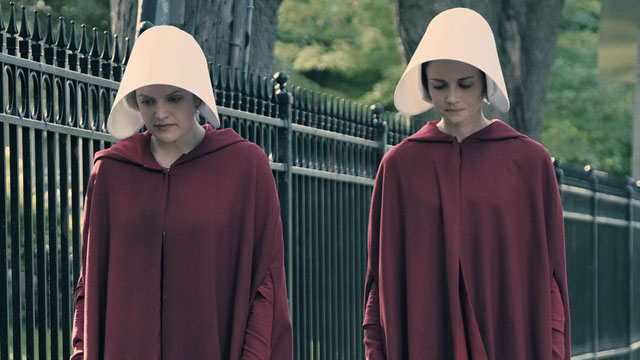
A chair. A table. A lamp. There's a window with white curtains, and the glass is shatterproof. But it isn't running away they're afraid of. A Handmaid wouldn't get far. It's those other escapes. The ones you can open in yourself given a cutting edge. Or a twisted sheet and a chandelier. I try not to think about those escapes. It's harder on Ceremony days, but thinking can hurt your chances. My name is Offred. I had another name, but it's forbidden now. So many things are forbidden now.
· · ────── ꒰ঌ·✦·໒꒱ ────── · ·
The Handmaid's Tale has everything I love in fiction. Post-apocalyptic dystopia, dictatorial regime, religious terror, and animalistic manifestations of human nature where you question everything that can make a person human.
I remember I started watching this series in 2023 and stopped somewhere at the beginning of the fourth season, although this is usually common for me when I want to grind down a series in one sitting, and now I wanted to take a break between anime and movies, so I decided to start over series again. I haven't been able to read the book, so I have no idea how much it differs, so I can't make comparisons, so my posts will only be about the series.
The story takes place primarily in an alternate universe, United States, more precisely in the already renamed Gilead, and we can see it from the point of view of Handmaid named June (Offred), who - and many other women like her - is used as breeding cattle. Of course, this is much better presented in the propaganda of the universe: People have poisoned the environment with chemicals, spread immorality, and abort their children on their own, so God cursed humanity with a plague that sterilized both men and women to teach them a lesson and lead them back to the right path. For this reason, God has given the remaining fertile women the sacred mission of sleeping with the master of the house in the presence of his wife within the boundaries of a ceremony, so that a child may be born from this holy intimacy.
Now, what does this look like in reality? The Republic of Gilead, the fundamentalist theocracy and dictatorship, where a caste system has emerged, and at the top there are the Commanders (military and religious leaders) who rape the Handmaidens in the presence and help of their Wives; if the Handmaid succeeds in conceiving child, the Wife takes the child as her own, and the Handmaid is transferred to another family with a perfect recommendation. If they are dissatisfied with her services, the Handmaid goes to the Colonies to clean up nuclear waste. It's a brilliant demonstration of when women are exalted for their reproductive abilities, but it's really about nothing more than dehumanization.
Of course, the Handmaids don't serve out of their own pious sense of duty. Women who were deemed sinful based their previous lives before the establishment of the system (children born out of marriage, extramarital relationships, homosexual relationships, abortions, etc.) become Handmaidens, but because they are fertile, they are gathered into a re-education camps, where the Aunts - responsible for education and morality - physically and mentally beat the propaganda into their head, and then they are assigned to families to give birth to children. Again, a another very sick but sadly existing depiction where women are actively and gladly contributing for upholding the system because they believe what they do is right.
In the first episode, we saw another caste, the Marthas, a social caste of lower-ranking women who do housechores for families, and they also briefly introduced the caste of lower-ranking men, who can gain a higher status if the Commander they serve under grant them a wife
Actually, we got a very impressive picture of how Offred lives her everyday life - the girls are not allowed to use their own names, so they are made to take the name of the master of the house - and while she is doing her duty, she also has to help with the housework, but she cannot leave the house alone; She has to go to the store with another Handmaid, which makes their social life more lively (from the outside), but is really used to spy on each other and keep each other on their toes.
Two scenes were very striking for me. After the rape, Mrs. Waterford cried. Well, not because she felt so sorry for the poor Handmaid, she doesn't give two shit about Offred. In my interpretation, even if she has the status of a Wife, even if she has the highest rank a woman can reach, it doesn't worth shit. She is just as worthless as a woman as the ones she despises in this society, and she knows this very well.
The other scene is Salvaging, which is a very nice name for Public Execution. This is also a psychological warfare, where the Handmaids are rounded up and the men who violate the Handmaids are executed by them, especially that such crimes are highlighted like raping a Handmaide, raping a pregnant Handmaid and causing miscarriage. The family is not named who suffered this tragedy, so this event is not about grief and support, and we can ask whether the accusation is fabricated (after all, we are talking about a dictatorship) or true. But whether it's real or not, it doesn't matter. What matters is that if Aunt says that girls have to execute this man, then girls will execute this man. And so they did. This is how fascists rallies their subjects. Through extreme emotions, not facts. And rape and hurting children or mothers is ALWAYS a touchy subjects, no matter what spectrum of the political scale you are on.
Just like Mrs. Waterford's crying scene was not about feeling sorry for the violence, but self-pity and anger for herself, the girls did not attack the man because they felt sorry for that girl or her miscarried child. These girls were angry. They are angry, oppressed, and constantly terrified. And that was the only legal way to take out all this frustration on someone who potentially deserved it on paper: a rapist. a child killer. a lawbreaker.
And actually there is a third scene too. That's a bit personal actually. Where Janine's prosecution and blamed for being tortured, making her responsible for her torturers scooping out her eye for being bratty. Aunt Lydia used this typical trick I remember from my own active religious days: whatever obstacles happening, whatever bad things are happening with you, it's because God is testing you and God is teaching you a lesson. If you make a mistake, if you misbehave and bad things happening to you, it's on you and solely on you. There are no evil people, only people with not enough faith.
Even if I didn't remember the plot of the series that much, the characters stayed with me all along and that is very rare when I'm watching a live action show. And what powerful characters they are!!! June, Mrs. Waterford. Moira. Emily. Janine. Aunt Lydia. I loved them all.
I don't know if I'm going to write about every episode, but I definitely wanted to mention this series and I hope to be able to finish it this time.

